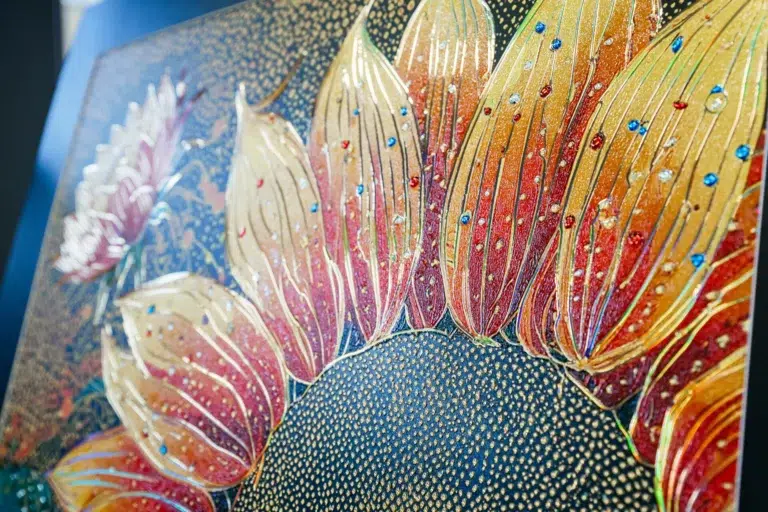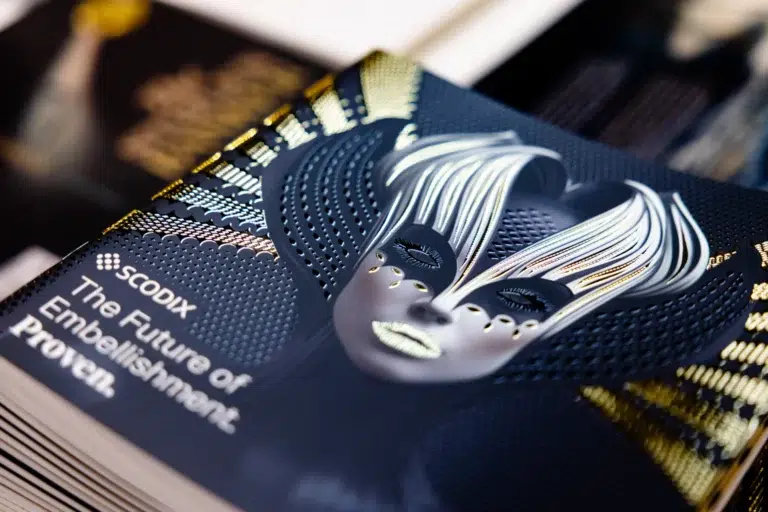


Bring your print to life with Scodix Foil™. Discover the UV-based inkjet technology behind Scodix Foil™ applications.
What is Scodix Foil™ and What Is It For?
Foil is used in a wide array of applications – from high-end retail packaging for beauty and health products, as well as the Spirits industry. Additionally, foil is commonly used on book covers, stationery, collectible cards, greeting cards, certificates, and more. It’s well-known for adding a touch of luxury and prestige to the final product.
In the past – larger volumes were needed for the addition of foil to a project to justify the costs associated with make-readies and the foiling dies required to apply the foil to the printed piece. Printers everywhere laugh at the request for one-off prints to “see how it’s going to look”…simple put – it’s not been cost effective.
One of the biggest opportunities Scodix Foil™ offers is the ability to add foil to any run length – even as low as one. Additionally, with a PDF-based workflow system in place, variable data print projects can integrate unique foil patterns on each and every sheet – leaving audiences to truly feel like they’re a part of a luxurious experience.
Add Variable Foil in Any Color of the Rainbow, On Demand!
We understand that there is a wide array of color needs when it comes to foil. Designers and brands everywhere want to ensure that their foil doesn’t clash with their overall design. With this in mind, we built the Scodix Foil™ system to support existing foil supplies in the marketplace.
How Does the Scodix Foil™ System Work?
Our Scodix Foil™ system is a three-step UV-based process that transforms a printed sheet into an embellished beauty.
The Pinning Stage
The first step in the process is known as the Pinning stage. This lays our specially formulated polymer down on the sheet in the desired selective image area. Flow of the wet liquid polymer is quickly frozen in place with the assistance of the first LED UV station.
The polymer acts as the foundation of the enhancement. Its precise control allows for both flat and raised foil effects, depending on design needs.
Activating the Polymer
The second station the sheet hits is the “Activate” station that hits the polymer again with a low-output of traditional UV power. This turns the polymer into an adhesive that enables the foil to adhere to the sheet – only where the enhancement is desired. Once the polymer is “activated,” the foil film touches the activated polymer and the colored layer peels off the foil film liner and adheres to the polymer.
The Curing Stage
After the foil is applied down onto the activated polymer – each sheet is sent through a final traditional UV station for curing. This ensures a high-quality, scratch-resistant foil is secured to the sheet for any additional finishing processes that may need to be performed.
Why Choose Scodix Foil™ Over Traditional Hot Foiling?
- Traditional hot foiling methods rely on metal dies or plates that must be custom-made for every design. With Scodix, foiling is fully digital, eliminating the need for tooling entirely.
- With no tooling or lengthy setup required, Scodix Foil™ makes small batches – even one-off jobs – economically viable.
- The absence of tooling and extensive setup also accelerates time-to-market, enabling foiling in hours instead of the days needed for traditional hot-foiling processes.
- This streamlined process makes Scodix Foil™ an environmentally responsible solution, supported by a fully certified LCA.
- The digital approach also allows the use of real foil for mock-ups and packaging prototypes during design and approval stages.
- Without traditional tooling limitations, Scodix Foil™ can be applied multiple times on the same sheet for a single job, opening up creative possibilities previously unattainable.
- Scodix Foil™ enables intricate patterns, fine text, gradients, and layered designs – all without the constraints imposed by conventional equipment.
Foil Options & Design Guidelines
Designing for Scodix Foil™ is both flexible and precise. The foil itself comes in a wide range of color options, including classic gold and silver as well as holographic and custom shades. To ensure optimal results, designers should prepare foil elements as a separate layer in their design file.
For a full set of specs, Scodix offers a downloadable design guide to support smooth production.
FAQs about the Scodix Foil™ Process
Can Scodix Foil™ be used for short/ one-off print jobs?
Yes. Scodix Foil™ based on a PDF file is like any type of digital printing process and can be used for one sheet or for tens of thousands of sheets. From one-off to unlimited number of sheets – all based on the customer requirements.
What types of foil and materials are compatible with Scodix Foil™?
Scodix has a list of recommended types of foil to use on our Scodix presses. Those foils work on a huge variety of materials starting with regular coated papers, through uncoated papers, plastics, corrugated stock, cardstock, laminated sheets, printed sheets with variety of CMYK inks and many more.
How is Scodix Foil™ different from traditional foil stamping?
Scodix Foil™ is a unique process using only polymer to adhere the foil to the substrate.
Unlike hot foil stamping which uses dies, pressure and high heat – Scodix uses a PDF file and polymer-to-glue-to-foil.
Unlike cold foil stamping, which consumes large amounts of foil during setup and is suited mainly for very long runs with flat foil sheets, Scodix Foil™ offers setup in just a few minutes with virtually no waste – delivering both raised embossing and flat foil effects with the same minimal effort.
Is Scodix Foil™ environmentally friendly?
Scodix offers a significantly more environmentally friendly solution compared to traditional foiling methods. A comprehensive Life Cycle Assessment (LCA) shows Scodix is, on average, 85% more sustainable than hot foil stamping, which relies on dies and lengthy setup processes.
Can Scodix Foil™ be combined with other print enhancements?
Yes. Scodix Foil™ can be applied before or after other types of embellishments such as laminations or coatings, embossing or cutting, etc. Because Scodix does not impact or damage the substrate, it is more suitable to be used before or after with other types of embellishments.